
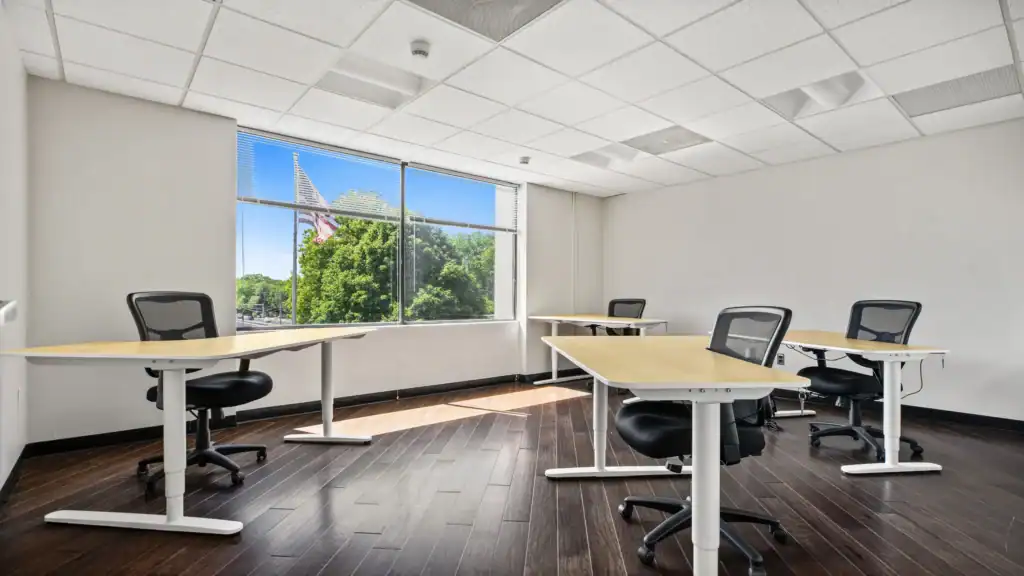
Bright team office with four desks, chairs, and large window overlooking trees.

The national commercial real estate publication spotlights how LocalWorks built a profitable, bootstrapped coworking company – without venture capital, without long-term leases, and without losing sight of who office space has historically left out.

Bisnow, one of the most widely read publications in commercial real estate, featured LocalWorks CEO Barry Greenfield in its ongoing “Innovators” series – a profile reserved for people and companies pushing the CRE industry forward in meaningful ways.

The feature examines how LocalWorks built a profitable, 37-location flexible office network spanning the suburbs of Boston, Washington D.C., and Chicago, all without outside investment and without the long-term lease obligations that have sunk other coworking operators.

It’s a model that’s easy to overlook because it doesn’t come with a splashy rebrand or a venture capital war chest. That’s precisely what makes it worth paying attention to.

Starting Small in Salem, Massachusetts

LocalWorks traces its roots to 2012, when Greenfield needed workspace for a small team and wasn’t willing to run a company out of his house. He found space in downtown Salem, Massachusetts, brought in a few friends and colleagues to share the cost, and discovered something simple but durable: people will pay for a clean, quiet, affordable private office.

The company grew from that single Salem location by word of mouth, expanding slowly until 2019, when LocalWorks landed a partnership with Cummings Properties – a large Massachusetts property owner with vacant space it hadn’t been able to fill through traditional leasing.

That partnership became the template for everything that followed.

The Model: Second-Generation Space, No Build-Out Required

Where most coworking operators sign long-term leases and spend heavily on renovation and interior design, LocalWorks takes a different approach. The company targets what it calls “second-generation space” – previously built-out offices that need little more than carpet cleaning, paint touch-ups, and furniture installation before they’re ready to rent.

This keeps startup costs minimal, allows LocalWorks to open a new location in as little as two to four weeks after signing with a landlord, and removes the financial risk that has proven fatal to larger, more capital-intensive coworking brands.

Rather than signing a lease, LocalWorks enters into a management agreement – typically five years, with an exit option after year one – and operates as an in-house coworking partner for the property owner. Greenfield described the pitch to landlords plainly in the Bisnow interview: LocalWorks fills the space with individual tenants, handles all operations, and gives property owners a revenue-generating use for space that might otherwise sit vacant.

“We’ll do everything,” Greenfield told Bisnow.

Profitable, Bootstrapped, and Built to Scale Without Venture Capital

At a time when the coworking sector’s biggest names were imploding under the weight of aggressive expansion funded by outside capital, LocalWorks was quietly growing on its own cash flow.

Greenfield noted to Bisnow that the company has been profitable virtually since it launched. It has never taken a dollar from venture capitalists or private equity. Across more than 35 locations, LocalWorks has maintained approximately 5% vacancy – a number that held even through the height of the COVID-19 pandemic, when the company continued operating and attracting members who needed to get out of their homes to work.

The contrast with WeWork and similarly funded operators is not incidental. Greenfield built LocalWorks specifically to avoid the capital structure that made those companies fragile.

“We’ve been able to keep expenses in line with where we can grow,” he told Bisnow. “We felt we did not have the background or experience for venture capital to come in, especially after what happened with WeWork.”

Democratizing Office Space: Two-Thirds Women, 60% People of Color

Perhaps the most striking detail in the Bisnow profile is the composition of LocalWorks’ membership.

Roughly two-thirds of LocalWorks members are women. Around 60% are people of color. Greenfield attributes this primarily to price – LocalWorks offers private offices starting at $495 per month, a figure that makes professional workspace accessible to founders and independent professionals who have historically been priced out of the corporate office market.

“We like to think of ourselves as democratizing office space,” Greenfield told Bisnow. “Just because of our price points, it allows more people who normally would not have access to corporate office space to have access to it through us.”

The Bisnow feature frames this as an innovation in itself: serving the middle and bottom of the market, rather than competing for enterprise clients, has produced a membership that reflects the actual makeup of the small business economy far more accurately than most coworking operators.

Private Offices, Not Open Floor Plans

LocalWorks is deliberately structured around private offices rather than the hot desks and open floor plans that defined the first generation of coworking. This too is by design.

The company’s typical member is a 30- to 60-year-old professional who needs a quiet, productive space – not a community event calendar or a referral network. Many members aren’t in their office every day. They want reliable high-speed internet, cleanliness, and a professional address.

On the address point: Greenfield noted that roughly 25% of LocalWorks members join primarily because they need a physical business address – a requirement for creating a Google Business Profile and establishing a credible online presence. For small business owners, that alone is worth the membership.

Expanding Into the DMV and Chicago

Following the success of its Massachusetts locations, LocalWorks expanded into the Washington D.C. suburbs during the pandemic, opening its first D.C.-area location in Bethesda, Maryland, followed quickly by a second in Alexandria, Virginia.

The suburban focus is not accidental. Greenfield has consistently prioritized locations close to where members live, not where corporate headquarters are concentrated. As hybrid work has taken hold across the DMV and Chicago metro areas, that positioning has become a competitive advantage: workers who no longer commute downtown five days a week still need a professional space to work – just one that’s closer to home.

LocalWorks has also begun expanding into sublease arrangements, helping companies that reduced their office footprint during the pandemic generate revenue from space they’re no longer fully using. A 2nd Bethesda location opened as LocalWorks’ first sublease-based site, under a revenue-sharing agreement with the original tenant rather than a traditional lease.

What the Bisnow Recognition Means

Being featured in Bisnow’s Innovators series is not a routine press mention. The series highlights companies and individuals that are demonstrably changing how commercial real estate operates – not just growing, but growing in ways that challenge the assumptions of the industry.

For LocalWorks, the recognition reflects a model that other operators, landlords, and property managers are starting to notice. The company’s approach – low overhead, rapid deployment, suburban focus, and accessible pricing – offers a template for making flexible office space sustainable at a time when the coworking industry’s biggest players have struggled to stay solvent.


About LocalWorks

LocalWorks is a flexible office space management company that partners with property owners to operate coworking environments and affordable office space rental services in suburban markets. With locations in the suburbs of Boston, Washington D.C., and Chicago, LocalWorks offers private offices on flexible terms starting at $495 per month – no long-term lease required.

Find a LocalWorks location near you: localworks.us


As featured in Bisnow, May 9, 2021. Update was made on June 2, 2026, to reflect new information such as prices and locations.